




Misplaced kindness fails people more than tough honesty does
New managers who freeze before hard talks, and leaders stuck with polite but stagnant teams, will see exactly where their feedback goes wrong.
IJR · Oct 7, 2026 · 6 min read
The big idea
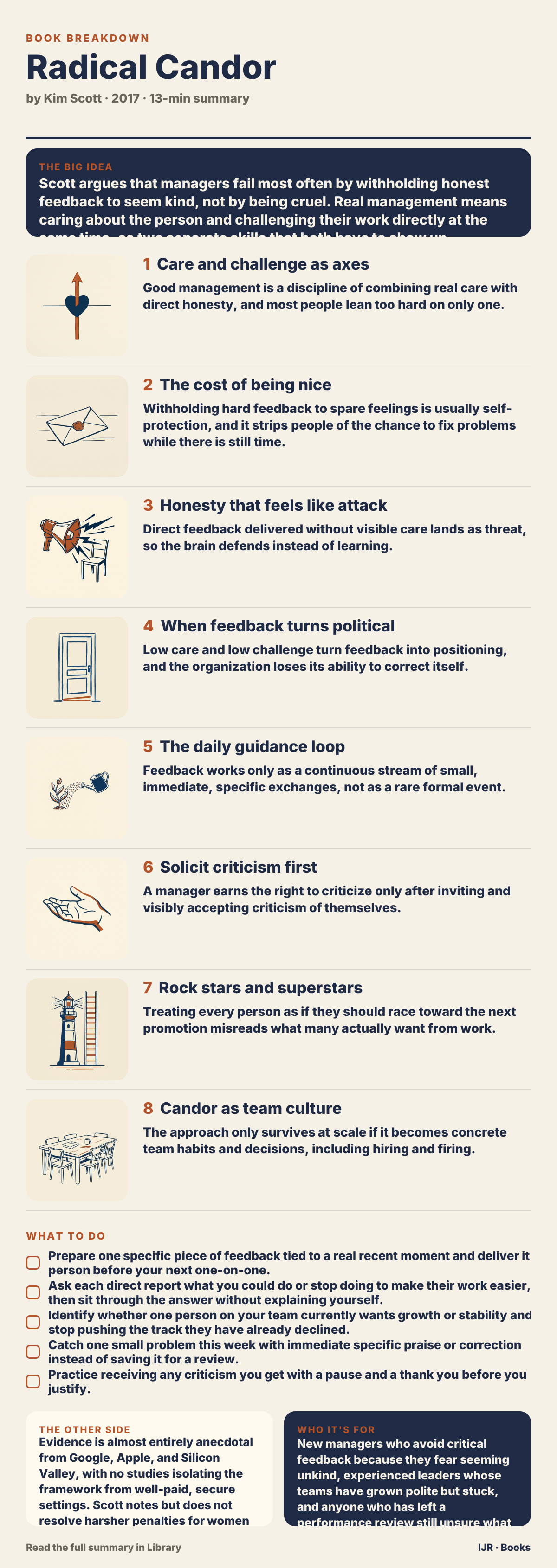
Scott argues that managers fail most often by withholding honest feedback to seem kind, not by being cruel. Real management means caring about the person and challenging their work directly at the same time, as two separate skills that both have to show up.
The key ideas

Scott plots two independent dimensions: how much you show you care about someone personally, and how directly you challenge their work when it falls short. High on both is the target; most failures come from neglecting one axis while overdoing the other, not from bad intentions.
Her own wake-up came after a solid Google presentation when Sandberg pulled her aside and said she said “um” so often it made her sound less sharp than she was. Scott’s first flash was defensiveness, then the realization that no one else had bothered to tell her something fixable. Silence dressed as kindness had cost her.

Scott calls high care with low challenge ruinous empathy, and treats it as the most common American management failure because it looks virtuous. The manager who softens every note about sloppy work or a credibility-killing habit tells themselves they are being considerate; often they are just dodging their own discomfort.
She kept doing this with a well-liked teammate she calls Bob whose work had slid for months, until she had to fire him. He was genuinely surprised. Nothing in his reviews had prepared him. The same pattern at team scale produces pleasant faces, gossip behind backs, stalled careers, and blowups that earlier small corrections could have prevented.

High challenge with low care is what Scott names obnoxious aggression: the boss who names exactly what is wrong but humiliates rather than informs. She watched Jobs do this in meetings, telling people their ideas or thinking were simply bad in blunt, cutting terms. The substance was often right; the delivery made people defensive and taught them to hide problems.
Without evident personal investment, feedback triggers the same alarm as a personal attack and shuts down processing. The recipient spends energy on the injury instead of the fix. Scott also notes the uneven cost: women and people from some racial and cultural backgrounds who try the same blunt style often get penalized harder than men.

Manipulative insincerity is the quietest quadrant: praise given to get something, or a rival’s mistake left unmentioned because their failure helps you. It thrives after people have been burned by aggression or exhausted by false kindness and decide honesty is not worth it.
Once a few people start managing impressions, everyone else learns to read between the lines. Trust thins. Scott’s recurring picture is the peer who nods agreement in the room then criticizes the plan privately afterward. That pattern, she says, can wreck a team faster than any single bad decision because every later agreement becomes suspect. Judge feedback by whether it aims at the other person’s improvement or your own standing.
Scott treats the annual review as nearly useless for real change: it arrives too late, too rarely, and after the details have gone fuzzy. Instead she wants a loop—feedback given constantly, in small doses, close to the moment the behavior happened, preferably in person so tone is not stripped away.
Be specific (“that report was unclear”) rather than vague (“communicate better”). Keep a rough mix of praise and criticism delivered the same way, or people tune out the criticism or stop trusting the praise. She compares it to exercise: one giant session a year does far less than frequent small repetitions. Trust accumulates through many small honest exchanges, which also keeps hard conversations rare because problems stay small.

Most feedback pushes fail because bosses start criticizing before the team believes criticism can safely flow both ways. Scott’s sequencing rule is simple: ask for criticism of your own work first, using a concrete prompt rather than a vague “any feedback,” then receive the answer without defensiveness or later coldness.
The hard part is the flash of justification that almost everyone feels. The only useful first move is a pause, a thank you, and actual change. The first time honest feedback backfires, the loop breaks for good. This step matters most for people with power over careers, because the employee has far more to lose.

Scott distinguishes superstars—people on a steep growth path who want more responsibility—from rock stars, who are excellent at their current role, deeply valuable, and content to stay there. Most review systems and promotion cycles are built only for the first group, so steady high performers get quietly labeled unambitious.
Forcing rock stars into growth stories they do not want either pushes them out or promotes them into roles they dislike and do poorly. The same person can be one or the other in different seasons of life. The caring move is an honest conversation about which trajectory they are actually on right now, then matching guidance and opportunities to that choice instead of a single org-chart template.

Left as one manager’s personal style, it dies when that person leaves or gets busy. Scott wants practices that lock it in: skip-level conversations, rotating who leads meetings so juniors practice speaking candidly, and spoken norms that treat silence in a meeting as a red flag rather than consent.
She extends the same logic to letting people go. Avoiding a clear firing is ruinous empathy paid for by the rest of the team and by the person who never got a usable signal. If the guidance loop has been running, a firing should never be a surprise; the specific concerns should already have been heard multiple times.
What to do
- Prepare one specific piece of feedback tied to a real recent moment and deliver it in person before your next one-on-one.
- Ask each direct report what you could do or stop doing to make their work easier, then sit through the answer without explaining yourself.
- Identify whether one person on your team currently wants growth or stability and stop pushing the track they have already declined.
- Catch one small problem this week with immediate specific praise or correction instead of saving it for a review.
- Practice receiving any criticism you get with a pause and a thank you before you justify.
The other side
Evidence is almost entirely anecdotal from Google, Apple, and Silicon Valley, with no studies isolating the framework from well-paid, secure settings. Scott notes but does not resolve harsher penalties for women and marginalized people who are blunt. The approach assumes cultures where direct confrontation is safe, which is riskier in hierarchical or high-power-gap workplaces, and the rock-star label can become a biased way to write people off.
Who it's for
New managers who avoid critical feedback because they fear seeming unkind, experienced leaders whose teams have grown polite but stuck, and anyone who has left a performance review still unsure what actually needs to change will get the most from reading the full argument and its concrete habits.